7 minute read
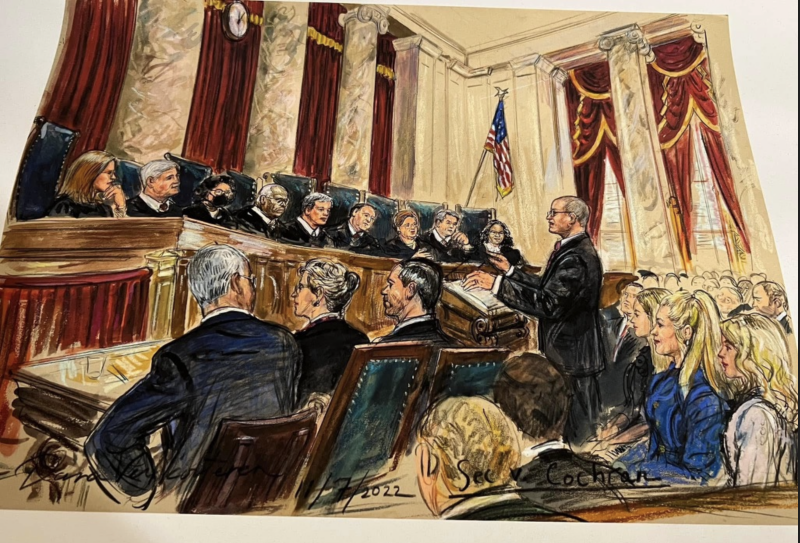
On November 7, 2022, I sat in the Supreme Court chamber and watched nine Justices hear arguments in a case with my mom's name on it: Securities and Exchange Commission v. Cochran.
My mom, Michelle Cochran, is a CPA. She worked as an auditor at a small Texas accounting firm until 2013. Three years after she left, in 2016, the SEC brought an enforcement action against that firm and named her too — not for fraud, not for dishonesty, but over incomplete audit checklists from 2010, when my sister and I were three and five years old. She represented herself in the early stages of the fight, against a team of SEC attorneys, in front of a judge who worked for the same agency prosecuting her. In our family, we didn't call that a technicality. We called it a home-court advantage, because that's what it was.
In 2017, that judge ruled against her: a $22,000 fine and a five-year ban from practicing as an accountant before the SEC. It could have ended there. Most people in her position settle — my mom has said close to 95% do, often under a gag order, before a case ever reaches a hearing. She didn't know that statistic going in. She just refused to back down.
In 2018, the Supreme Court's decision in Lucia v. SEC forced the agency to admit its administrative law judges hadn't even been appointed correctly, and my mom's case got reassigned to a new judge for a do-over. But she'd already found the deeper problem, and it wasn't going away with a new judge: the ALJs hearing SEC cases were shielded from removal by layers of job protection that, she argued, made them unaccountable to anyone — the same theory the Supreme Court had already accepted in a related case, Free Enterprise Fund v. PCAOB. She wanted to challenge that structure directly, in a real federal court, before the SEC's in-house process ran its course. The SEC argued she had to finish their process first and could only raise that argument on appeal, years later. The New Civil Liberties Alliance took her case pro bono, and the fight went all the way to the Supreme Court to decide a single question: does she even get to make that argument in a real court, before the agency's process is done?
That's the argument I watched in person. Nine Justices, my mom's name on the docket, and my sister and I sitting in the chamber to see it happen. Cameras aren't allowed inside the Supreme Court, so the only visual record of that day is a courtroom sketch NCLA commissioned — my mom, in front of all nine Justices, with her daughters beside her. Almost a decade of fighting had led to that one morning.
On April 14, 2023, the Court ruled. Unanimously, in her favor.
The decision didn't declare the SEC's ALJs unconstitutional outright — that question technically went back down unresolved. What the Court decided was narrower and, in its own way, more important: someone challenging the constitutional structure of an agency doesn't have to survive years of that agency's own process before a real court will hear them. The claim is separate from the merits of the underlying case, and it's not something the agency itself has any special expertise judging, so it gets to go straight to a federal judge. My mom didn't win a ruling that the system was rigged. She won the right to say so in a courtroom that didn't work for the SEC.
It turned out that was enough. Seven weeks after the ruling, the SEC dismissed nearly every enforcement case it had pending in front of its in-house judges — 42 of them, some that had dragged on for years. Hers was one of them.
Then, in February 2025, in a related case, the Department of Justice's Solicitor General filed something almost unheard of: a formal notice reversing the government's own position, stating it would no longer defend the constitutionality of those same ALJ removal protections in litigation — the exact system my mom spent nearly a decade arguing was unaccountable. It wasn't filed in her case specifically. It didn't need to be. It was the government admitting, years later, that the structure she'd fought was exactly what she said it was.
My mom has said she's ready to tell this story herself, in full, and there's a lot of it that belongs to her to tell, not me. What I keep coming back to, watching it unfold from where I sat, is how much of the system's power depends on nobody pushing back. The right to challenge an agency's authority in a real court technically exists for everyone. Almost nobody has the standing, the resources, or the refusal to settle that it actually takes to use it. My mom did. My grandfather, Norm Goheen, spent his career teaching government and believed in exactly this — that the Constitution only means something if someone is willing to stand on it. I think about that every time I hear someone say the system doesn't work. Sometimes it's just never been tested by someone who wouldn't quit.
Key takeaways
- SEC v. Cochran decided a jurisdictional question — the right to challenge an agency's constitutional structure in federal court before its in-house process concludes — not the underlying merits of that challenge.
- The practical result still mattered: the SEC dismissed 42 pending enforcement cases, including my mom's, within seven weeks of the ruling.
- In February 2025, the DOJ formally reversed its own defense of SEC ALJ removal protections in a related case — validating, years later, the argument my mom made from the start.
- Rights on paper and rights in practice aren't the same thing. The difference is usually just someone willing to actually use them.